
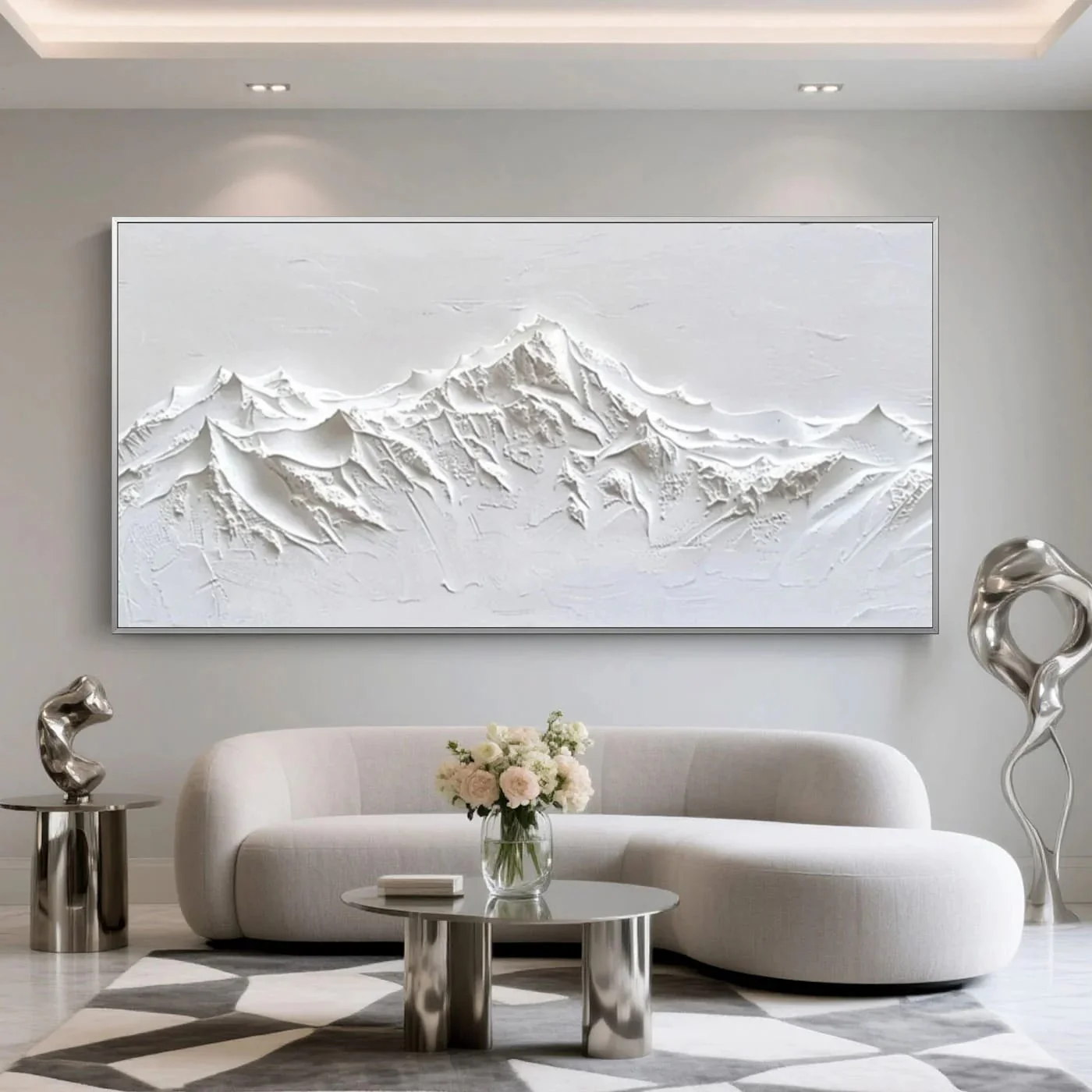
Simplicity, balance and emotional calmness—these are the principles of modern interior design. The aesthetic trends of today include clean layouts, neutral tones, and open spaces. But when walls are left completely blank, interiors can come across as visually empty or emotionally detached.
This proves to be one of the challenges for interior environments, but Mountain Wall Art has a compelling solution to solve this by seamlessly bringing in foreign imagery via natural scenery. Utilizing Textured Painting techniques, it transitions from a wall covering to 3D environment you can see in the round. The elements of texture and the decontextualization of landscape imagery are now successfully combined to create a sense of layeredness, action, and visual artistic character in contemporary interior spaces.
Mountain Wall Art Concept
Mountain Wall Art Is a Creative Interpretation, Not a Literal Reproduction Instead of exact, scale-centred details of actual mountains, it is about form, flow and feeling.
It is not just realism, but a balanced portrayal of nature in artistic abstraction. You used shapes, layers, and contours to suggest forms of mountains, valleys & landscapes with no detailing.
This makes it ideal for contemporary interiors where understated, purposeful design prevails over the richness of fine detailed or visually weighted artwork. It fits easily into minimal spaces while still bringing a sense of character and presence.
How Textured Painting Hits The Surface Of Landscape Art
Natural landscapes are so dimensional that much of the time, traditional flat paintings fail to express what they want. Mountains IRL have three dimensions to them, even weirdo-shaped ones like that one: they exist in space and not just as projections upon some kind of flat surface.
The texture or embossed layer would not be printed, so this limitation is avoided by bringing physical layers onto the surface through a technique called Textured Painting. These forms reproduce a tactile sense of the ground and bring the artwork into three dimensions.
This technique helps create:
Realistically volumetric and sculptural mountain ridges
The natural interaction of light and shadow
A real sense of height and depth
A more immersive visual experience
That is why Mountain Wall Art is not just a painting, it becomes an artistic sculpture of nature.
What are the Materials for Textured Mountain Art
When doing texture, use characteristics of material that can be layered, shaped, and control the surface to create Mountain Wall Art. Usually artists are combining both tradition and modern with respective mediums to obtain the desired effect.
Common materials include:
Plaster or modeling paste, to create structural depth
Acrylics, laid on for natural color mixing and tone variation
Palette knives. This will work for rough terrain definitions and edges
Layering tools — for detailing texture and surface features
The combination of these materials provides both a physical base to enforce the optical illusion, and tactile visual weight. The end result is a textured piece that brings forth both an organic, structured and naturally expressive feeling.
Step-by-Step Artistic Approach
Build the Base Landscape
The process that begins with a simple torus. A more kindly horizon line, or background shape, is established to purvey the composition itself. Phase 1 establishes the ground for depth and structure.
Add Mountain Shapes
The first layer is used to lay down a base, and then thicker layers are put on it until mountains starts forming. The elevated shapes in the work create elevation and focal points.
Refine Textures
Surface detailing is subsequently layered on top of the main structure. They give the effect of genuine rock, slopes and irregular natural texture of rough and smooth to create textures. This step adds realism and variation to the composition.
Apply Natural Colors
Color application is done without hard edges, heavily relying on browns, grays, greens and lighter neutrals that you might encounter from a naturally occurring palette. This, in turn, complements and underlines the effect of nature and landscape identity in this work.
Interior Design Impact
Textured Painting | Mountain Wall Art has a much bigger impact on the inside environment from what it is. It brings calmness inspired by nature into contemporary spaces in an artistically sophisticated way.
This kind of art is particularly powerful in:
Homes that are minimalistic and allow for a little bit of visual depth!
Huge, modern and luxurious interiors need subtle centers of attention
Calm Spaces in Nature to Relax and Find Your Balance
Fed working spaces which foster concentrated and creative work
Mountain-inspired textures help the interiors ground, making them feel stable, calm and emotionally attached.
The Emotional Connection to Nature
The strongest point Mountain Wall Art presents is a close contact between interiors and nature. Modern life within the city, ultimately spends the majority of their day with synthetic environments. Utilizing this creates a psychological void in natural visuals.
This need is fulfilled by the textured landscape art which emits individual natural forms through artistic means. It is not just about beautifying a wall, but bringing the tranquility of outside into indoors.
That emotional connection is what gives it more power than your average piece of decorative art.
Conclusion
Textured Painting Mountain Wall Art takes your home from mundane to nature-filled murals. Sculptural texture, layered depth and abstract landscape shapes united in one composition of art, emotion, and inspiration through nature.
Beyond mere decoration, it takes on an immersive design role in modern interiors adding depth, tranquility and natural beauty.